

Many businesses in Ahmedabad choose metal fabrication partners based primarily on the lowest price. In a competitive industrial hub, saving money upfront feels like a smart move for the bottom line. However, focusing only on the quotation often hides the true cost of a project. When the price is too low, it usually means the fabricator is cutting corners in areas that are not immediately visible.
Making a decision based solely on cost can lead to serious operational hurdles later. A part that is slightly off-measure or a weld that is weak can stop an entire production line. This guide helps business owners and procurement managers understand the balance between what they pay and what they actually receive. By shifting focus from “cheapest” to “best value,” companies can ensure smoother operations and fewer technical headaches.
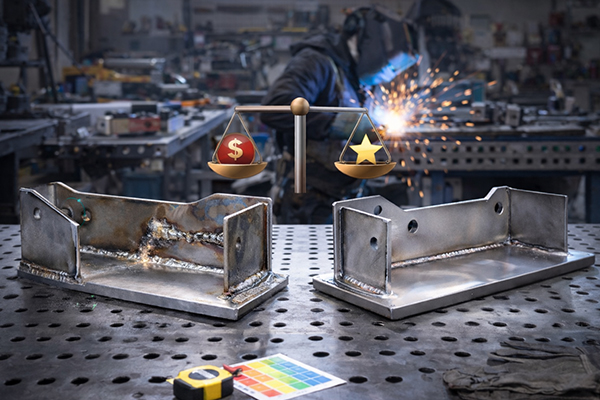
How Industries Define “Cost” in Fabrication
To make a smart choice, you must understand what makes up a fabricator’s price. It is rarely just the weight of the metal.
What “Quality” Actually Means in Metal Fabrication
Quality is not just a vague word; it is a measurable standard of work.
Accuracy of Cutting and Bending
Does the part match your technical drawing exactly? Even a 2mm error can make a part useless during assembly.
Strength of Weld Joints
Good welds are deep and clean. Poor welds look like “caterpillars” on the surface but have no internal strength, leading to cracks.
Dimensional Consistency
If you order 100 pieces, the 1st piece and the 100th piece should be identical.
Surface Finish
The metal should be free of burrs (sharp edges), scratches, or rust.
Durability
The fabricated item should be able to handle the stress, heat, or weight it was designed for without bending or breaking.
Where Cost and Quality Conflict
In the fabrication world, you often have to choose between two paths.
Hidden Cost Areas Most Industries Ignore
A “cheap” part can become very expensive once it enters your factory.
- Rework and Correction: If a part doesn’t fit, your team has to grind, weld, or cut it again. This wastes your labor time and electricity.
- Production Downtime: If a fabricated component fails on a machine, your entire production stops. The cost of one hour of idle factory time is often more than the “savings” from a cheap vendor.
- Machine Fitting Problems: Parts that are not square or flat put stress on your expensive bearings and motors, causing them to wear out faster.
- Loss of Reputation: If you use poor fabrication in a machine you sell to a client, your brand name suffers when that machine breaks down.
Smart Ways to Balance Cost and Quality
- Ask Technical Questions: Instead of asking “Can you do it cheaper?”, ask “What machine will you use for this bend?” or “How do you check for weld defects?”
- Compare Process, Not Just Price: If one quote is 30% lower than others, ask the vendor to explain their workflow. They might be skipping the cleaning or inspection stages.
- Inspect Sample Work: Before a big order, ask to see a sample of a similar project. Look at the corners and the underside of the welds.
- Check Material Standards: Ask for “MTC” (Material Test Certificates) to ensure you are getting the specific grade of steel you paid for.
Decision Matrix for Fabrication Buyers
| Decision Factor | Low-Cost Choice Result | Balanced Quality Choice Result |
| Material Quality | May use non-certified or rusted metal. | Uses graded metal with mill test reports. |
| Precision | Higher tolerances (errors of 1mm to 3mm). | Tight tolerances (errors less than 0.5mm). |
| Welding | Basic tack welds; high chance of leaks/cracks. | Full penetration, clean, and strong welds. |
| Assembly Time | Slow; parts require “adjustment” to fit. | Fast; parts “snap” together perfectly. |
| Longevity | Short life; prone to rust or structural failure. | Long life; handles industrial loads reliably. |
Simple Buyer Checklist
Smart Buyer Checklist for Metal Fabrication in Ahmedabad
- [ ] Does the vendor have the specific machines (Laser, CNC, TIG/MIG) required?
- [ ] Is the material grade clearly mentioned in the quotation?
- [ ] Has the vendor agreed to the specific tolerance levels (e.g., +/- 0.5mm)?
- [ ] Are the finishing requirements (powder coating, galvanizing) documented?
- [ ] Will the vendor provide an inspection report for the finished batch?
- [ ] Is the packaging sufficient to prevent damage during local transport?
Industries Where Cost vs Quality Decisions Matter Most
- Machine Manufacturers: Precision is vital for moving parts.
- Automotive Suppliers: Components must meet strict safety and fitment standards.
- Electrical Panel Builders: Enclosures must be perfectly square and weather-proof.
- Infrastructure Contractors: Structural integrity is a matter of public safety.
- Heavy Engineering Units: Large-scale components must handle massive vibrations.
- OEM Equipment Manufacturers: High-volume parts must be identical for global assembly.
FAQ’s on Metal Fabrication Services
Check the edges and joints. Smooth edges and uniform, “row-of-coins” style welds are signs of a skilled fabricator.
It fails because vendors use lower-grade metal, skip heat-treatment processes, or use unskilled labor to save on wages.
Look at the weight of the material and the list of services included. One might include sandblasting and priming, while the other does not.
It is okay for non-critical items, like simple storage racks or basic scrap bins, where precision and aesthetics do not matter.
High quality reduces the “Total Cost of Ownership.” You spend less on repairs, replacements, and wasted production time over the years.
Conclusion
Choosing a metal fabrication partner in Ahmedabad is a balance between your current budget and your future operational success. While the pressure to reduce costs is always present, the risks of poor quality—such as machine failure and rework—usually outweigh the initial savings. By focusing on technical clarity, material standards, and precision, you ensure that your industrial components support your business growth rather than hindering it.
Would you like me to create a technical questionnaire you can send to your potential fabrication vendors to help vet their quality standards?