

Ahmedabad has long been the industrial heartbeat of Gujarat, housing thousands of manufacturing units, pharmaceutical plants, and engineering hubs. However, for a purchase manager or a factory owner, finding a metal fabrication partner who truly understands industrial standards is a constant challenge. Many local workshops promise low costs but often struggle with precision, leading to parts that don’t fit or structural failures during assembly.
The primary concerns for businesses today are consistent quality and predictable delivery timelines. A delay in receiving a fabricated frame or a batch of laser-cut components can halt an entire production line, leading to massive financial losses. Trust is hard to build when there is a lack of transparency regarding material grades or welding standards. This guide aims to help you navigate these challenges and identify a partner who adds value to your supply chain.

What Does a Reliable Metal Fabrication Partner Mean?
In simple terms, a reliable partner is a company that delivers exactly what they promised, on the date they promised it. In the world of metalwork, reliability isn’t just about “doing the job.” It means:
Reliability matters because fabrication is often the foundation of your final product. If the foundation is weak or crooked, the rest of your project will suffer.
Why Choosing the Right Fabrication Partner Is Critical for Industries
Selecting the wrong vendor doesn’t just result in a bad part; it creates a domino effect of problems:
Impact on Production
If a fabricated component arrives late or faulty, your assembly team sits idle.
Safety Risks
In heavy engineering, a poor weld can lead to structural failure, risking lives and expensive machinery.
Hidden Costs
Cheap fabrication often requires “rework” at your site, which ends up costing more than hiring a premium partner in the first place.
Long-term Performance
High-quality finishing and machining ensure that your equipment lasts for years without rusting or breaking.
Industries That Benefit From Reliable Fabrication
In the fabrication world, you often have to choose between two paths.
Key Factors to Identify a Reliable Fabrication Partner
Experience in Metal Fabrication
Look for a company that has spent years working with different metals. An experienced team knows how different materials react to heat and pressure, which prevents warping and deformities.
Availability of Modern Machinery
Manual work has its place, but industrial-grade fabrication requires precision technology. Check if the partner uses:
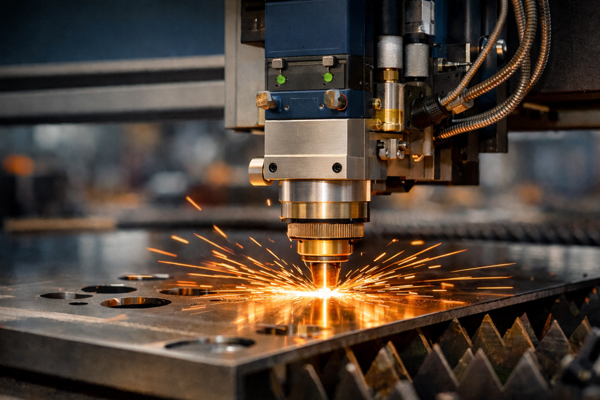
- CNC Laser Cutting: For clean, sharp edges.
- CNC Bending: For accurate angles and repeatability.
- VMC Machining: For high-precision holes and slots..
Skilled Workforce and Technical Knowledge
The machines are only as good as the people operating them. A reliable partner employs engineers who can read complex CAD drawings and skilled fitters who understand assembly tolerances.
Quality Control Process
Does the company have a dedicated QC department? They should check the dimensions and material quality at every stage—from raw material arrival to the final coat of paint.
Ability to Handle Custom Fabrication
Every project is unique. A good partner should be flexible enough to handle custom prototypes and one-off designs rather than just mass-producing simple parts.
Accuracy and Consistency
In B2B manufacturing, “close enough” is never good enough. A reliable fabricator uses calibrated measuring tools to ensure every dimension meets your specifications.
Welding Quality and Finishing Standards
Welding is the soul of fabrication. Look for clean, uniform weld beads (TIG/MIG) without cracks or holes. The finishing (powder coating or galvanizing) should be smooth and durable.
Timely Delivery Commitment
A professional company provides a realistic timeline and sticks to it. They should have a system to track production progress and keep you updated.
Transparent Pricing and Quotations
Reliable partners provide a detailed breakup of costs, including material, labor, and finishing. Beware of “lump sum” quotes that might hide poor-quality materials.
After-Support and Accountability
If something goes wrong after delivery, a true partner doesn’t disappear. They take responsibility, offer rectifications, and work to ensure the problem doesn’t happen again.
Problem-vs-Solution Table
| What to Check | Risk If Ignored | How a Reliable Partner Helps |
| Machinery Type | Inaccurate cuts and rough edges | Uses CNC technology for perfect precision |
| Material Grade | Rapid rusting or structural weakness | Provides material test certificates (MTC) |
| Welding Quality | Joints breaking under heavy loads | Employs certified welders for high strength |
| Workforce Skill | Misinterpretation of design drawings | Expert engineers ensure design compliance |
| Lead Times | Delayed projects and lost revenue | Strict production planning for on-time delivery |
Checklist to Identify a Reliable Metal Fabrication Company in Ahmedabad
- [ ] Do they have an ISO certification or industry-specific licenses?
- [ ] Can they provide Material Test Certificates (MTC) for the steel used?
- [ ] Do they have in-house laser cutting and CNC bending machines?
- [ ] Have they worked on similar projects in your specific industry?
- [ ] Is their workshop clean, organized, and safety-conscious?
- [ ] Are they willing to show you their recent work or provide references?
- [ ] Is the quotation detailed and easy to understand?
FAQ Section
A reliable partner will always provide a Material Test Certificate (MTC) from the supplier, proving the grade (like SS 304 or MS Grade 1) matches your order.
CNC bending uses computer-controlled machines to ensure every bend is at the exact same angle. Manual bending often leads to variations that make assembly difficult.
Yes, many experienced fabricators have design teams who can review your drawings and suggest “Design for Manufacturing” (DFM) changes to save costs and improve strength.
It depends on the complexity, but a professional unit usually provides a timeline of 7 to 21 days for standard industrial batches.
Usually not. Very low prices often mean the fabricator is using inferior material, unskilled labor, or skipping quality checks, which costs you more in the long run.
Conclusion
Choosing a metal fabrication partner in Ahmedabad is a decision that impacts your entire production cycle. While price is always a factor, it should never come at the expense of accuracy and reliability. By focusing on technical capabilities, quality processes, and transparent communication, you can build a partnership that lasts for years.
A reliable partner does more than just melt and bend metal; they act as an extension of your own manufacturing floor, ensuring that every part delivered contributes to your business success.